

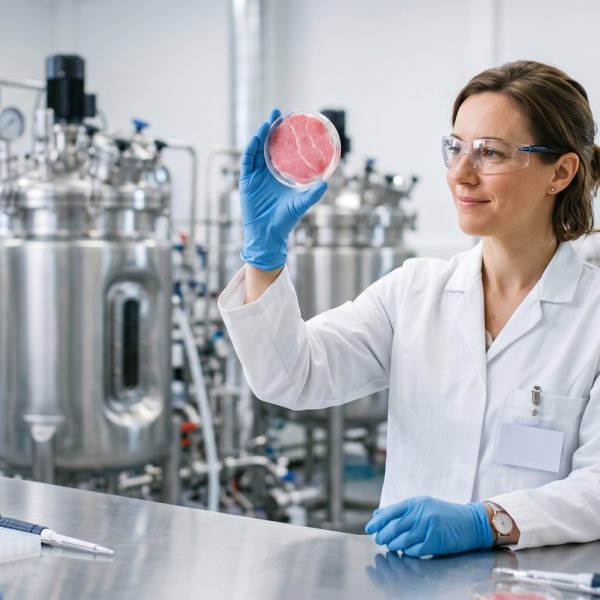
For most of human history, meat meant an animal. That link is now being tested in laboratories and pilot factories where companies grow muscle tissue from cells, with no slaughter required. So what is lab grown meat, really, and is it a genuine shift in how we eat or just an expensive science project? The idea has moved from novelty to a serious corner of biotech, and it is worth understanding before it turns up on a menu near you.
What is lab grown meat, in plain terms
Lab grown meat, also called cultivated or cultured meat, is real animal tissue produced without raising and killing an animal. Scientists take a small sample of cells, often from a living animal through a harmless biopsy, and coax those cells to multiply. Given the right nutrients and conditions, they grow into the muscle and fat that make up what we recognize as meat. The result is not a plant based imitation. On a biological level it is the same kind of tissue you would find in a conventional cut, which is exactly why it draws so much attention and so much argument.
How is lab grown meat made
The process starts with cell lines that can divide many times over. These are placed in a bioreactor, a large steel vessel not unlike the ones used to brew beer or make vaccines. Inside, the cells float in a nutrient rich liquid that feeds them sugars, amino acids, vitamins and growth factors. Over days and weeks the cells multiply and are nudged toward becoming muscle. To build texture, producers use edible scaffolds that give the cells a structure to grow along, since a nugget is easy but a marbled steak is genuinely hard. Understanding how lab grown meat is made helps explain why the first products are minced or blended rather than a perfect ribeye. The Wikipedia entry on cultured meat traces how the science moved from a single 2013 burger that cost a fortune to today's pilot plants.
Lab grown meat vs real meat
The honest comparison is nuanced. In the debate over lab grown meat vs real meat, supporters point to land and water savings, fewer animals raised in tight conditions, and a lower risk of the diseases that pass from livestock to people. Critics counter that the energy needed to run sterile bioreactors is far from trivial, and that the climate benefit depends entirely on where that energy comes from. There is also the plain matter of taste and price. Conventional meat is cheap and familiar, and any newcomer has to match it on both fronts before shoppers switch. It is a similar tension to the one facing vertical farming, where impressive technology still has to prove it can beat an open field on cost.
Is lab grown meat safe, and is it legal?
Safety is the question regulators care about most, and the early signs are cautious but positive. In the United States, agencies have cleared cultivated chicken from a couple of companies, and Singapore was the first country to allow sales. Producers argue that growing meat in a controlled, sterile setting can actually reduce contamination risks like salmonella that come from processing whole animals. Still, the field is young, long term studies are limited, and approval so far covers only a handful of products. When people ask whether lab grown meat is safe, the fair answer is that what has reached the market has passed review, while the broader story is still being written.
Lab grown meat reaches a plate through a supply chain most people never picture, involving bioreactors, regulators and a great deal of cost engineering. Consumer electronics hides an equally long chain behind a very short launch event. The latest phones arrive after two or three years of component negotiation, which is why the interesting decisions were all made long before anyone saw the product.
Cultured meat is often discussed in terms of Western consumer choice, though its likely significance is elsewhere. Protein security matters most where supply is least reliable. Any honest assessment of its impact sits alongside questions like what are remittances actually fund in the households receiving them.
When will it actually reach your plate?
Slower than the headlines suggested. A few restaurants have served cultivated chicken as a limited, pricey experience, but supermarket shelves are years away for most people. The bottleneck is scale. Growing a tray of cells is one thing, growing millions of tonnes at a price that competes with a chicken breast is another entirely. Companies chasing that goal are also expanding across borders, which means working through different food rules and, in practice, translating labels, safety files and marketing for each market. That is where careful business document translation before going global becomes part of the story, since a promising product can stall on paperwork it never prepared.
Why it matters even if you never try it
Whether or not cultivated meat wins over your dinner plate, the research is pushing biotechnology forward in ways that spill into medicine and materials. The same cell culture skills feed work on tissue engineering and regenerative therapies. Communities like the r/cultivatedmeat community track each new plant and approval in close detail, a sign of how many people see this as more than a fad. The likeliest future is not lab grown meat replacing farms overnight, but a slow blending of old and new, with cultivated protein filling a niche and the technology quietly improving much of what sits around it.
Recent Posts

Pourquoi les biotechs ne conqu...

5 Innovative Biotech Firmen di...

Vers une médecine personnalis...

What Biotech Breakthroughs Are...

How Editing and Proofreading S...